By Squirrel for Mayor
Panama Flats—a 26-hectare wetland and meadow system in Saanich between Interurban and Carey—has been at the centre of a region-wide conversation about how we share urban nature. On January 12, Saanich Council made an important move by rezoning the Flats as a bird and nature sanctuary, formally recognizing one of the region’s most significant urban wildlife habitats.
The rezoning reflected months of work by nearly two dozen organizations, First Nations, and community groups who agreed the future of Panama Flats should prioritize biodiversity, wildlife habitat, and ecological restoration—while still allowing people to enjoy the park. But one key issue was left unresolved: what rules should apply to dogs on the main gravel trail that runs alongside sensitive wetlands.
That question came to a head at the January 26 Saanich Council meeting, and the council has now made a clear decision.
Council’s Decision on January 26: Dogs Must Be Leashed
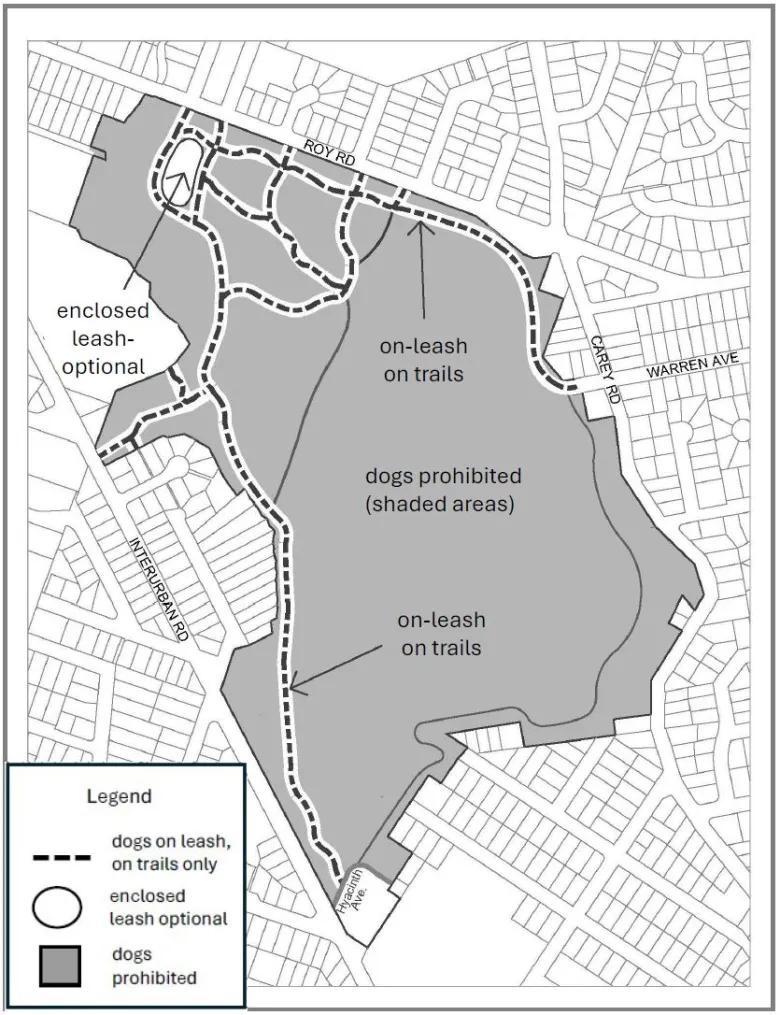
At its January 26 meeting, Saanich Council voted to adopt amendments to the Animals Bylaw governing dog access at Panama Flats that prohibit off-leash dogs throughout most of the park, including the Colquitz Trail that borders the wetlands, unless they are kept on leash.
This means that:
- Dogs may enter the park and trail network, but must be on leash at all times along the sensitive corridor adjacent to the wetlands.
- Proposals for any leash-optional segment—such as earlier concept plan provisions for a fenced, off-leash bit between Hyacinth Park and Roy Road—were removed from the bylaw, and off-leash access will not be permitted in this corridor without significant further review.
The motion to remove off-leash provisions along the Colquitz Trail was seconded by Councillor Karen Harper and supported by a majority of council members.
Why Conservation Groups Supported the Outcome
Conservation advocates like Nature Victoria had urged the council to support a 24/7 on-leash requirement because Panama Flats functions not just as a public park, but as a working wetland, wildlife corridor, and migratory bird habitat. Wetlands and meadow systems are crucial for feeding, nesting, and rest during migration; even well-behaved dogs can disturb birds and other wildlife at critical times. Their voices highlighted the urgency of habitat protections amid accelerating bird population declines.
Supporters also noted that:
- A leash-only policy would reduce potential disturbances to nesting birds and other vulnerable species.
- It would make rules consistent across the park and avoid the need for costly fencing or enforcement solutions that could themselves create ecological or management issues.
Public Perspectives: Not “Dogs vs. Nature”
Hundreds of community members wrote and spoke to council on both sides of the issue. Many dog owners expressed frustration that prior discussions about a leash-optional trail segment did not result in a compromise. Others, including letter-writers and naturalists, emphasized that leash-only rules are not an attack on dogs but a practical way to protect an irreplaceable ecosystem.
Below is a letter submitted to Saanich Council in advance of the decision:
Dear Mayor and Council,
January 25, 2026
Dear Mayor and Council,Thank you for your January 12 decision to re-zone Panama Flats to a higher level of environmental protection, recognizing its importance as a wildlife refuge. This was a meaningful and long-overdue step that reflects the ecological reality of the site: Panama Flats is not simply a park, but a recovering wetland and a critical wildlife corridor embedded within the Garry oak and Coastal Douglas-fir ecosystem—one of the most endangered ecological communities in Canada.
I strongly support the option before Council on January 26 to require dogs to be on-leash 24 hours a day along the main gravel trail between Roy Road and Marigold Road.
Panama Flats has been at the centre of a difficult community debate between off-leash recreation and ecological protection. What is often missing from that discussion is a basic truth: for birds, amphibians, and other wildlife, Panama Flats is not a place for exercise or leisure—it is their home. They cannot choose a different park or a quieter trail. When disturbance becomes too great, their only options are to leave, fail to reproduce, or disappear. This is how biodiversity is lost.
The wetland and surrounding Garry oak meadow support nesting birds, migratory species, amphibians, pollinators, and rare plants that depend on predictable, undisturbed habitat to feed, rest, and raise their young. Off-leash dogs, even when well-behaved, introduce constant movement, scent-marking, and chase responses that disrupt these essential life processes and push wildlife out of the very spaces that Council has now recognized as worthy of protection.
Nature Victoria, along with many scientists and conservation organizations, has therefore endorsed the 24/7 on-leash option as the most effective and practical way to protect the wetland and its wildlife. A consistent on-leash requirement also improves safety for walkers, cyclists, and dogs, and avoids the need for an expensive fence that would require ongoing maintenance and could create risks for wildlife, such as animals becoming trapped or separated from their young.
Bird populations have declined by nearly 50% globally, and more than three billion birds have been lost in North America in the last 50 years. Climate change is accelerating habitat loss, altering migration timing, and reducing food availability. In this context, small urban wetlands and Garry oak ecosystems like Panama Flats have become critically important refuges in an increasingly fragmented landscape.
By adopting a 24-hour on-leash requirement, Council can ensure that its January 12 rezoning decision is translated into real, on-the-ground protection for the species that depend on this place for survival.
Thank you for your leadership in safeguarding Panama Flats as a living ecosystem, not just a recreational space, for the benefit of the entire community and future generations.
Sincerely,
[Letter excerpt inserted in full from user-provided text]
What This Means for the Future of Panama Flats
Council’s January 26 decision enshrines a leash-only approach along the most ecologically sensitive parts of Panama Flats. This outcome reflects a broader municipal and community commitment to balancing recreational use with strong habitat protection.
For pet owners, Panama Flats remains a place to walk with dogs — just on leash. For nature lovers and wildlife advocates, this decision means greater protection for a key urban ecosystem that supports migratory birds, waterfowl, and other species under pressure from habitat loss and climate change.
As Panama Flats evolves under its new sanctuary status and bylaw protections, it stands as a test case for how urban nature spaces can be managed equitably and sustainably.
https://www.timescolonist.com/local-news/no-dogs-in-panama-flats-unless-theyre-leashed-11796229