By Squirrel for Mayor
Setbacks are often treated as a technical zoning detail—numbers on a site plan to be minimized in the pursuit of density. In reality, setbacks are one of the most powerful tools a city has to protect its urban forest, safeguard biodiversity, and uphold climate resilience and public safety. In the City of Victoria, where the entire urban area sits within the Garry oak ecosystem, setbacks are not a luxury. They are a prerequisite for ecological survival.
Victoria Is a Garry Oak City—Whether We Acknowledge It or Not
Vancouver Island lies within the Coastal Douglas-fir biogeoclimatic zone, the most at-risk ecological zone in British Columbia due to cumulative pressures from development, agriculture, and logging. Within this zone sits the Kwetlal food system—colonially termed the Garry oak ecosystem (GOE). The Garry oak tree, the keystone species, emerged following glacial retreat approximately 8,000 years ago and is now largely confined to the Metro Victoria region.
The open woodland structure of Garry oak landscapes did not occur by accident. It is the result of millennia of Lekwungen agroecological land management and is recognized by Lekwungen speaking peoples as a living cultural artifact. Without this stewardship, the region would naturally transition to closed-canopy Douglas-fir and grand fir forests.
While relatively intact Garry oak ecosystems persist in some regional parks, up to 75% of Garry oak trees and modified Garry oak ecosystems are located on private land—the very land most vulnerable to redevelopment pressure. These trees are not incidental landscaping features. Garry oaks are long-lived keystone species supporting more than 1,645 co-evolved plants, insects, birds, mammals, amphibians, and reptiles, many of which do not occur in wildland forests elsewhere.
Some trees on private properties in Victoria exceed 250 years of age, meeting the Province of BC’s definition of old growth for coastal forests. These trees are locally adapted, genetically distinct, drought-tolerant, and exceptionally effective at mitigating flood risk and urban heat—benefits that cannot be replaced within human lifetimes once lost.
Reconciliation, Policy, and a Growing Disconnect
The City of Victoria’s Official Community Plan (OCP), adopted on October 2, 2025, includes Vision 2050 reconciliation commitments stating that the City will “seek to understand the practices that have supported ecosystem conservation for millennia and work collaboratively to braid Indigenous knowledge systems with Western science in preserving and enhancing natural assets, and in advancing a climate-forward city.”
This intent aligns with the work of plant ecologist and Indigenous scholar Robin Wall Kimmerer, who advocates for weaving Indigenous knowledge and scientific practice to repair relationships between people and land. Yet current bylaws, processes, and draft OCP policies undermine these stated objectives:
- The OCP’s new land-use classification scheme was developed without a city-wide biodiversity assessment on private land, limiting meaningful stewardship and evidence-based planning.
- Development Permit Areas include environmental protection requirements, yet urban forest design guidelines were created without Indigenous land managers, licensed ecologists, biologists, or urban foresters.
- The Tree Protection Bylaw (21-035) has not been updated to reflect post-2022 provincial housing legislation and cannot physically protect trees located within building envelopes.
- While the City reports a net gain of approximately 100 soccer fields of canopy over a decade, canopy growth has dropped by 50% in the last four years, resulting in a shortfall of roughly 23 hectares compared to previous growth rates.
These gaps matter because urban forest success is not measured by isolated gains, but by whether mature trees can be retained where they already exist.
Setbacks Are Often Mischaracterized as Anti-Housing
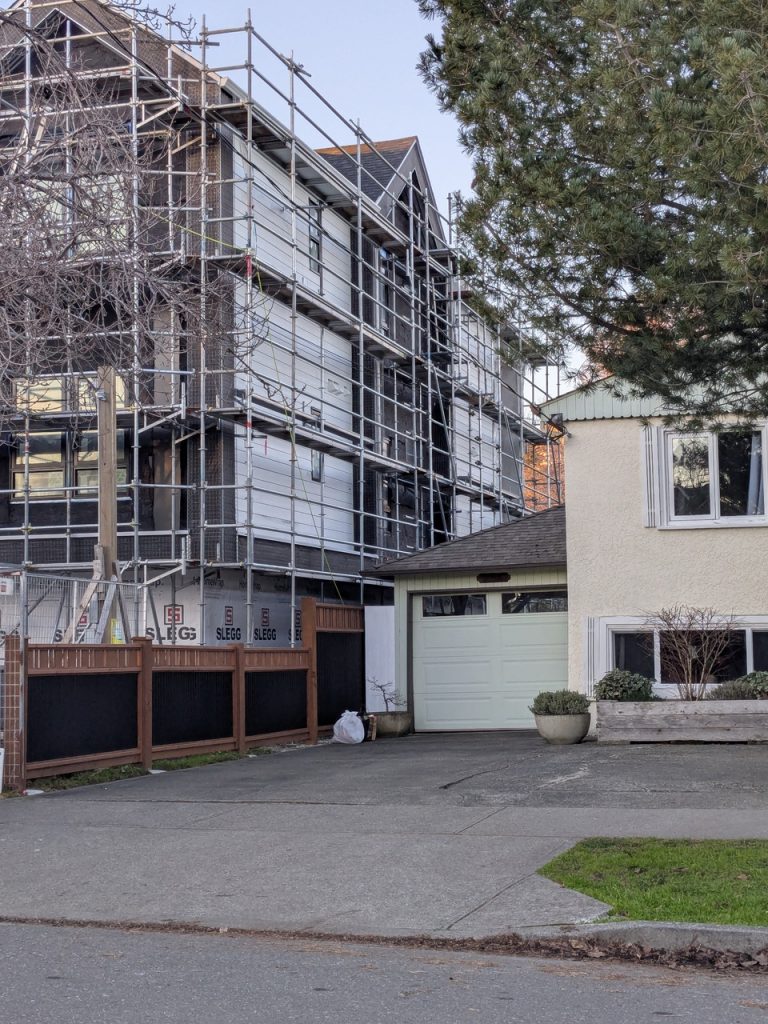
In today’s political climate, setbacks are frequently portrayed as anti-housing or as a driver of increased housing costs. This framing is both incomplete and misleading. Setbacks do not prevent housing from being built; they shape how housing is built in relation to land, infrastructure, safety, and ecological limits. The primary determinants of housing cost in Victoria are land speculation, financing, construction costs, and market dynamics—not the retention of a few additional metres of soil and tree-rooting space. In fact, reducing setbacks can increase long-term public costs by eliminating the urban forest services that moderate heat, manage stormwater, reduce flood risk, and protect public health—costs that are ultimately borne by municipalities and residents. Treating setbacks as a barrier to housing falsely pits affordability against livability, when in reality, climate-resilient, tree-retentive urban form is a prerequisite for stable, affordable communities over time.
Why Setbacks Matter in a Garry Oak Landscape
Setbacks are not arbitrary. They are the spatial mechanism that determines whether trees, soils, and ecosystems can survive alongside buildings.
Setbacks protect soil and root zones.
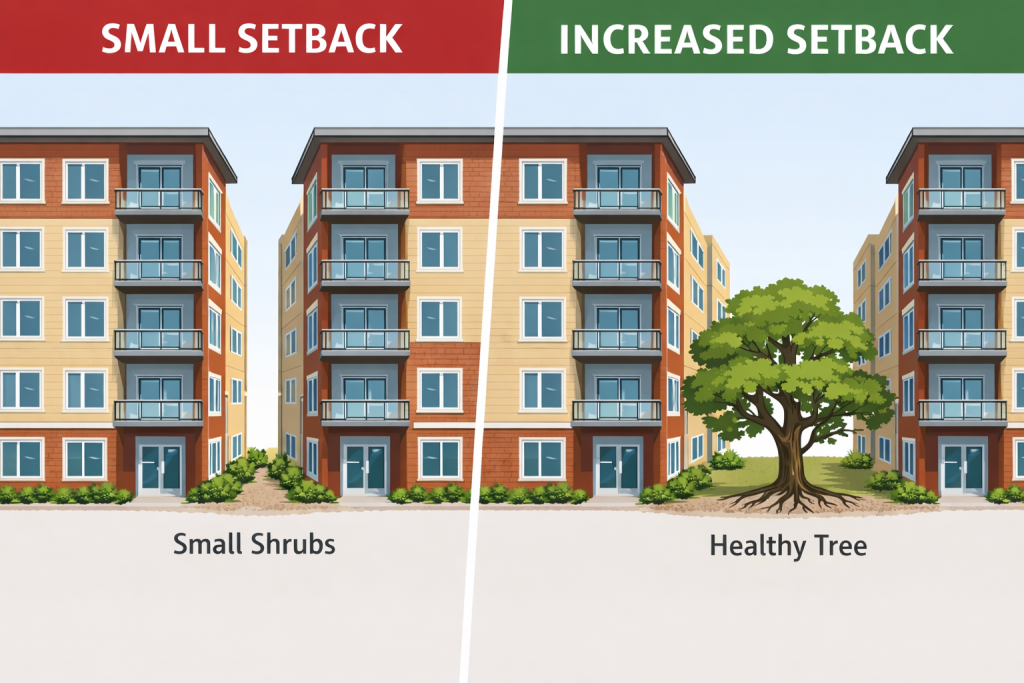
Large native trees require substantial, uncompacted soil volumes to thrive. A 6-metre backyard setback—now common in intensified zoning areas—provides little opportunity to retain existing large trees or to plant new ones capable of reaching maturity. Reduced setbacks effectively convert planting space into decorative greenery rather than functioning canopy.
Setbacks enable biodiversity on private land.
Ecological networks do not stop at park boundaries. They move through yards, hedgerows, and the spaces between buildings. Setbacks create micro-habitats for pollinators, birds, and small mammals—critical in a city where most Garry oaks exist outside protected areas.
Setbacks support public safety and climate resilience.
Space between buildings reduces fire spread, allows emergency access, absorbs stormwater, and mitigates extreme heat. As climate impacts intensify, these buffers become essential infrastructure, not optional design features.
Setbacks protect livability and health.
Light, air circulation, privacy, and access to green space are public-health assets. Removing setbacks increases overshadowing, noise, and stress—outcomes well documented in environmental psychology.
Policy Solutions Grounded in Ecology, Not Assumptions
To align stated climate and reconciliation goals with measurable outcomes, the following actions are required:
- Adopt a city-wide Garry oak species detection tool as part of ongoing urban forest remote-sensing updates.
- Establish an Urban Forest Technical Advisory Group, as recommended in the City of Victoria’s Urban Forest Master Plan (2012), with representation from Indigenous knowledge systems, ecologists, biologists, environmental organizations, and urban forestry experts.
- Recognize plantable space as a leading indicator of canopy success by restoring landscape area minimums from 6% to 9% in Priority Growth and Residential Infill areas.
- Increase all setbacks by a minimum of 2 metres specifically allocated to landscape (plantable) area, enabling large-canopy trees rather than medium or ornamental species.
- Update OCP language to protect modified Garry oak ecosystems and individual Garry oak trees, not only “intact” remnants.
Space Is the First Climate Action
Setbacks are not an obstacle to good planning—they are its foundation. Once soil is excavated and root zones destroyed, no amount of replanting can replicate the cooling, flood protection, habitat, and cultural value of a 200-year-old Garry oak. Replacement is impossible without setbacks sufficient to accommodate new large-tree species plantings. Density that erases ecological function is not climate-forward; it is ecological displacement.
In a city defined by a globally rare ecosystem, protecting space is not anti-housing. It is pro-future. The question is not whether Victoria can afford setbacks—but whether it can afford to lose what makes this place livable at all.
Sources
City of Victoria. Victoria 2050: Official Community Plan (with appendices). Official Community Plan Bylaw No. 25-045, Oct. 2, 2025. City of Victoria, Victoria, British Columbia, https://engage.victoria.ca/ocp/documents. Accessed 27 Jan. 2026.
City of Victoria. “Tree Canopy 2023.” Open Data Portal, opendata.victoria.ca, https://opendata.victoria.ca/documents/2f6665924f5747b69c07f103930ba77d. Accessed 27 Jan. 2026.
Squirrel for Mayor. “City of Victoria’s 2019-2023 LiDAR Vegetation Change Detection Analysis.” Squirrel for Mayor, 2 Apr. 2025, https://www.squirrelformayor.com/2025/04/city-of-victorias-2019-2023-lidar-vegetation-change-detection-analysis/. Accessed 27 Jan. 2026.