
Much of the public discussion about housing legislation has focused on what municipalities can no longer do.
Bills 44, 46, and 47 reduced local control over density and removed public hearings for many residential developments. As a result, communities across British Columbia have struggled with how to protect urban forests while accommodating growth.
Yet another piece of legislation passed in 2024 may offer municipalities new opportunities to shape greener communities.
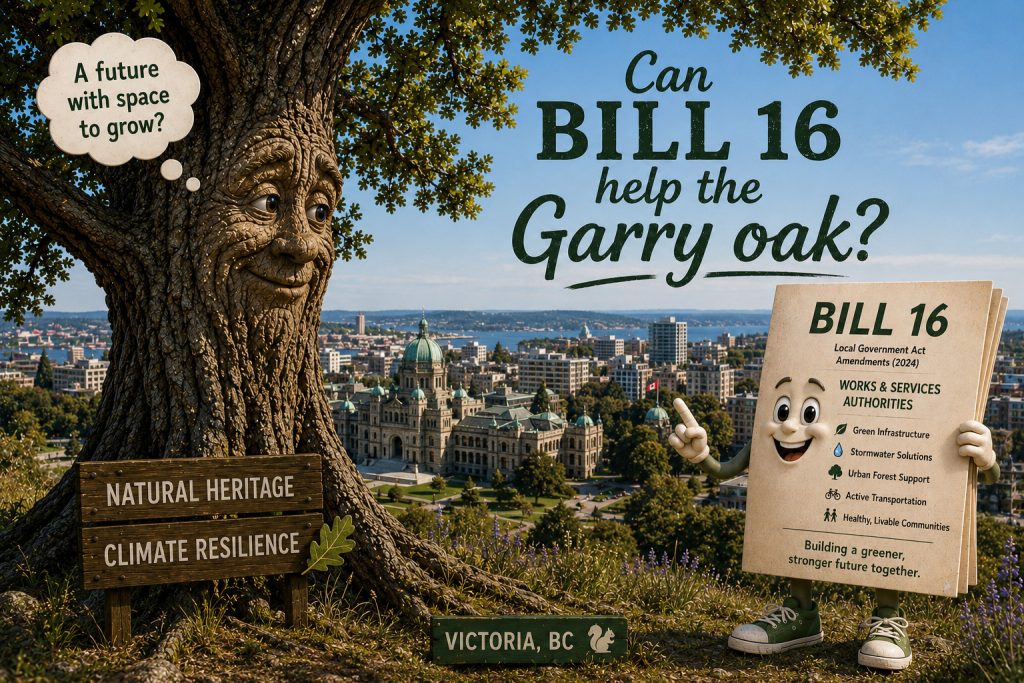
Bill 16 expanded local government authority to require “works and services” associated with development. While municipalities cannot use these powers to block housing that is already permitted under zoning, they can require infrastructure that supports transportation, climate adaptation, and community objectives.
To date, most municipalities appear to be using these new powers for transportation demand management measures such as cycling facilities, transit-supportive infrastructure, and public realm improvements.
What has received far less attention is the potential application to urban forestry and green infrastructure.
Bill 16 also highlights an overlooked reality of urban forest governance: the future of Victoria’s canopy may be determined less by tree bylaws and more by engineering standards. Soil volumes, street cross-sections, stormwater systems, and transportation infrastructure often dictate whether a tree can reach maturity. As growth accelerates, municipalities should explore whether servicing bylaws can be used to establish minimum standards for the infrastructure that supports large-canopy trees, biodiversity, and climate resilience.
Could municipalities require minimum soil volumes for street trees? Structural soils beneath sidewalks? Green stormwater infrastructure? Permeable surfaces? Shaded transportation corridors?
Another challenge receiving far less attention is the impact of reduced setbacks on the long-term viability of urban forests. As municipalities accommodate higher densities on increasingly constrained lots, buildings are often pushed closer together and closer to property lines. This reduces available planting space, limits soil volume, and can significantly diminish the sunlight available to both existing and future trees. While Bill 16 cannot change density requirements established by provincial legislation, it may provide municipalities with tools to improve the quality of the remaining landscape through infrastructure standards that support canopy growth, stormwater infiltration, and climate resilience.
These are infrastructure questions, not simply landscaping questions.
For decades, urban forest discussions have focused on protecting individual trees. Bill 16 raises a different possibility: ensuring that every new development contributes to the infrastructure needed to support large-canopy trees in the future.
Victoria’s challenge is no longer simply about planting replacement trees. The loss of contiguous plantable space on all development lots has created unintended consequences: cash-in-lieu funds are ballooning and being spent on items other than tree replacement because there is no more public space to plant trees removed from private property. Now we need to create the conditions that allow planting large at maturity trees the space to survive long enough to become part of the urban forest.
As growth continues across the region, municipalities should explore whether Bill 16 can support a new generation of tree-first infrastructure standards that integrate transportation, stormwater management, climate resilience, and urban canopy objectives.
If Bill 44 changed the conversation about density, Bill 16 may change the conversation about how that density is accommodated. Victoria’s urban forest is not simply a tree management issue. It is increasingly an infrastructure planning issue.
Resources
https://www.leg.bc.ca/parliamentary-business/overview/43rd-parliament/2nd-session/bills/1st_read/gov16-1.htm
https://www.bclaws.gov.bc.ca/civix/document/id/bills/billsprevious/5th42nd:gov16-1
City of Richmond – How Bill 16 is being used:
https://citycouncil.richmond.ca/__shared/assets/_2_-_Transportation_Demand_Management__TDM__Reserve_Fund_Establishment_PWT_12182475096.pdf?utm_source=chatgpt.com