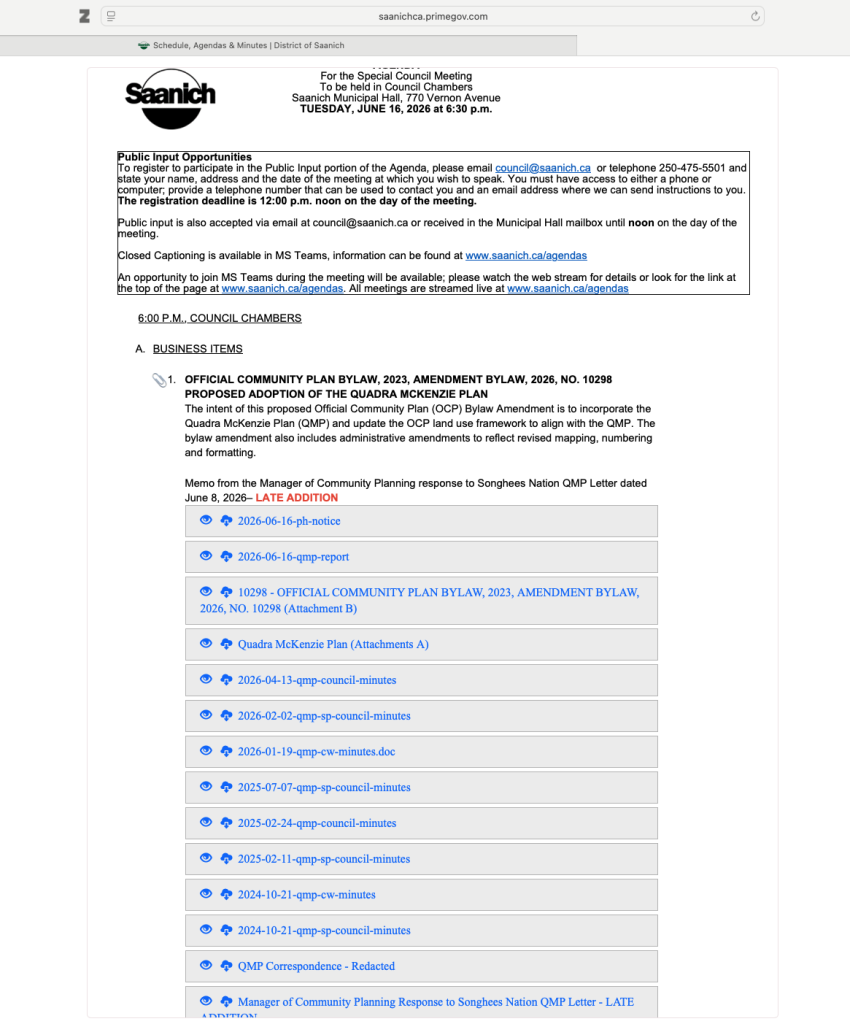
The Quadra McKenzie Plan (QMP) in Saanich is scheduled for a public hearing on Tuesday, June 16, 2026. The plan proposes significant growth over the next 20 years, concentrating housing and mixed-use development along the Quadra-McKenzie corridor and key transit routes. Its ambitious growth targets are largely driven by provincial housing mandates, illustrating how provincial requirements (Bill 44) are shaping the process more than local area planning.
A significant issue attached to the public hearing agenda is a letter from the Songhees Nation, which formally requests that Saanich postpone adoption of the plan until meaningful consultation can occur regarding Garry oak ecosystems, qʷɫaʔəl (camas) food systems, cumulative development impacts, and long-term stewardship planning.
The May 22 letter states:
“The Quadra McKenzie Plan fails to adequately recognize lək̓ʷəŋən Aboriginal Rights and does not provide meaningful protection for the qʷɫaʔəl food system from ongoing development pressures. The proposed land use framework continues patterns of fragmentation and loss affecting a critically endangered ecosystem that is integral to Songhees Nation’s constitutionally protected rights and cultural practices.”
The Songhees Nation specifically asks Council to:
1. Postpone adoption of the Quadra McKenzie Plan pending meaningful consultation with
Songhees Nation regarding Garry Oak ecosystem analysis, cumulative impacts, and longterm
stewardship planning;
2. Include clear Garry Oak and qʷɫaʔəl food system stewardship goals within the QMP,
supported by measurable targets and accountability mechanisms recognizing these
ecosystems as integral to Songhees Nation’s Indigenous rights and cultural continuity; and
3. Develop and implement a responsive management framework outlining mitigation,
restoration, and stewardship measures where ecosystem thresholds or stewardship goals
are not met due to development pressures.
The Songhees position goes beyond individual tree protection. It argues that Garry oak ecosystems and camas food systems should be recognized as interconnected cultural landscapes and living food systems rather than collections of isolated trees, and that this extends to the entire ecosystem that supports plants, pollinators, birds, animals, insects, and the cultural practices connected to them.
Their letter describes these systems as being tied to Aboriginal rights, stewardship responsibilities, food sovereignty, medicines, teachings, and the intergenerational transmission of knowledge. They are “not simply ecological features” but living cultural artifacts.
Saanich staff responded that the QMP is a high-level planning document and that issues such as cumulative effects assessment, ecosystem thresholds, restoration priorities, and long-term stewardship are better addressed through future implementation plans and related municipal initiatives.
The staff memo repeatedly suggests that these concerns can be addressed later through:
- Biodiversity Conservation Strategy implementation
- Urban Forest Strategy implementation
- Agriculture and Food Security Plan updates
- Future monitoring and reporting
- Future stewardship initiatives
rather than through amendments to the QMP itself.
Saanich staff are aware that Bill 44 significantly limits municipal authority to protect trees and environmental features that fall within a permitted building envelope on private property.
The problem is that up to 75% of the urban forest exists on private property, where redevelopment is occurring. As redevelopment intensifies, existing soil volumes, mature trees, and ecological functions are removed, while reduced setbacks leave increasingly limited opportunities for meaningful replacement planting. You’ve seen the results already – nothing but a larger building, more concrete features, and some smaller, non-native trees and grasses that can’t support nesting birds, or much else.
Saanich staff responded by discussing future reviews of development tools, integration of ecological objectives into parks and public spaces, monitoring programs, tree retention and planting on public lands, and outreach and educational support for stewardship on private lands.
Yet this raises an obvious question: who actually requires the outreach and education?
Most residents (minus the urbanists) already understand that mature trees, healthy soils, and connected ecosystems provide benefits for biodiversity, climate resilience, cooling, stormwater management, and quality of life. The larger challenge is that municipalities are being required to implement provincial housing legislation that unlocks private land for redevelopment while simultaneously reducing their ability to protect environmental features within development sites.
Bill 44 effectively prioritizes housing development within permitted building envelopes, limiting municipal authority to retain trees, soils, and ecological functions on many private properties. Since up to 75% of the urban forest exists on private land, it is these redevelopment decisions—not public park management—that will largely determine the future of urban biodiversity and canopy cover.
The Songhees Nation is asking Saanich to pause and first determine ecosystem thresholds, cumulative impacts, stewardship goals, and consultation frameworks before approving a growth plan that will guide development for decades.
Saanich’s response is that the growth framework should proceed now, while those details are addressed through other policies and implementation processes later.
The unanswered question is what happens after dozens—or hundreds—of redevelopment projects.
What is the cumulative ecological loss? What ecosystem thresholds exist? At what point is ecological connectivity broken? At what point does restoration become impossible?
Songhees Nation
May 22, 2026
District of Saanich Council
The Songhees Nation Land & Environment Department would like to reassert Chief
Sam’s statement (February 2nd, 2026):
Songhees Nation’s connection to qʷɫaʔəl (camas) food systems and qʷɫaʔəlʔənək
(Garry Oak ecosystems) remains deeply rooted in our ancestry, cultural practices,
stewardship responsibilities, and the intergenerational transmission of knowledge
and rights. These food systems are not simply ecological features, they are living
cultural artifacts that reflect Indigenous laws, governance, food sovereignty, and the
stewardship of our ancestors, particularly women and family groups who sustained
them over countless generations.
Today, only an estimated 1–3% of undisturbed qʷɫaʔəl food systems remain within
the Capital Regional District. Despite this severe decline, Songhees people continue
to rely on these ecosystems for traditional foods, medicines, harvesting practices,
cultural teachings, and ecological stewardship.
The Quadra McKenzie Plan (QMP) fails to adequately recognize lək̓ʷəŋən
Aboriginal Rights and does not provide meaningful protection for the qʷɫaʔəl food
system from ongoing development pressures. The proposed land use framework
continues patterns of fragmentation and loss affecting a critically endangered
ecosystem that is integral to Songhees Nation’s constitutionally protected rights and
cultural practices.
Saanich’s Urban Forest Strategy identifies Exceptional Trees requiring prioritized
protection and retention as trees that:
Hold cultural significance and are historically native to the land; and
Support biodiversity and provide significant ecosystem services that are difficult or
impossible to replace.
Songhees Nation emphasizes that these principles must extend beyond individual
trees to include the interconnections of qʷɫaʔəlʔənək (Garry Oak ecosystems) within
which they support various species. The ecosystem provides space and connections
for plants, trees, pollinators, birds, animals, and insects.
As the QMP will guide land use and growth over the next 20 years, its decisions will
have lasting impacts on Songhees Nation’s traditional lands, food systems, cultural
practices and medicines. These impacts require meaningful consultation with
Songhees Nation prior to the finalization or adoption of planning frameworks and
policy directions.
Songhees Nation respectfully requests that Council:
Postpone adoption of the Quadra McKenzie Plan pending meaningful consultation
with Songhees Nation regarding Garry Oak ecosystem analysis, cumulative impacts,
and long term stewardship planning;
Include clear Garry Oak and qʷɫaʔəl food system stewardship goals within the QMP,
supported by measurable targets and accountability mechanisms recognizing these
ecosystems as integral to Songhees Nation’s Indigenous rights and cultural
continuity; and
Develop and implement a responsive management framework outlining mitigation,
restoration, and stewardship measures where ecosystem thresholds or stewardship
goals are not met due to development pressures.
Songhees Nation looks forward to working collaboratively with Council and staff to
ensure future planning decisions respect rights, responsibilities, and the long-term
protection of these culturally significant ecosystems for future generations.
Sincerely,
Andrew Easson
Land Referral Guardian
Saanich staff replied om June 8th
Staff Response to Songhees Nation Letter on Quadra McKenzie Plan
To: Mayor and Council
From: Cameron Scott, Acting Director of Planning
Date: June 8, 2026
Subject: Staff Response to Songhees Nation Letter on Quadra McKenzie Plan
PURPOSE
This Memo provides a response to the letter dated May 22, 2026, from Songhees
Nation regarding the Quadra McKenzie Plan (QMP). It outlines how the concerns raised
are being addressed, in part, through the QMP’s existing policy direction, and identifies
additional opportunities to advance this work through implementation of the QMP and
other initiatives.
DISCUSSION
The Songhees Nation letter has raised concerns regarding recognition of lək ̓ ʷəŋən
Aboriginal Rights, protection of qʷɫaʔəl (camas) food systems and qʷɫaʔəlʔənək (Garry
Oak ecosystems), cumulative effects of development, and the need for meaningful
consultation and long-term stewardship.
Staff recognize the importance of these concerns and note that the Quadra McKenzie
Plan responds to these issues at a strategic level. It is important to consider that, as a
policy document within a defined geographic area of Saanich, there are inherent
limitations in what the QMP can address. Other Provincial and District of Saanich plans
and processes are better positioned to more concretely make progress on the issues
raised by the Songhees Nation.
Quadra McKenzie Plan Directions
The Quadra McKenzie Plan, in conjunction with the Official Community Plan, provides
higher level direction through broad land use and environmental objectives and policies.
Topic specific plans, such as the Urban Forest Strategy, informed the development of
the QMP, and will serve to provide more detailed actions to address key issues.
Additionally, specific site conditions will be analyzed and addressed through the
development application process.
The QMP contains significant environmental content at the objective / policy level.
Notably, the QMP has benefited from the recent adoption of the Biodiversity
Conservation Strategy and the Urban Forest Strategy. These strategies included
rigorous analysis, identification of key environmental assets, and District-wide policy
directions. The Quadra McKenzie Plan (QMP) reinforces this direction by including
policies that protect and enhance environmental features, support urban forest and
green infrastructure objectives, and guide growth in a way that is more coordinated. A
key element of this is the inclusion of Habitat Sites identified in the Biodiversity
Conservation Strategy. These sites, which are fully mapped in the QMP, are assigned
Special Site designations, which will ensure additional consideration of environmental
values and/or alternative development approaches are incorporated should these sites
be considered for redevelopment.
The concerns raised by Songhees Nation emphasize that Garry Oak ecosystems
should be considered at the ecosystem level, rather than only through protection of
individual trees or isolated features. Staff note that the QMP’s direction related to
connected open spaces, green networks, and environmental quality is consistent with
this broader systems approach. However, broader Provincial, regional, and municipal
approaches are needed to truly look at the best ecosystem-level approaches.
Implementation Initiatives
The Songhees Nation letter highlighted the need for cumulative effects assessment,
ecosystem threshold identification, restoration priorities, and responsive management
measures. These are important matters, but they are not typically resolved through
high-level Centre, Corridor and Village plans. In staff’s view, implementation activities
provide more practical and effective mechanisms to advance this work.
Quadra McKenzie Plan Implementation
As a long-range area plan, the QMP is intended to provide strategic policy direction,
including in the areas of environmental stewardship and land management.
Implementation of the QMP could provide an opportunity to further respond to the
concerns raised by Songhees Nation in a way that is tied to specific actions and
operational tools. This may include:
• Review of development-related tools to improve consideration of ecological
sensitivity, connectivity, and restoration opportunities.
• Integration of ecological objectives into public realm, park, and infrastructure
planning within the Plan area; and
• Development of monitoring and reporting approaches for environmental outcomes
associated with growth and redevelopment.
Agriculture and Food Security Plan Update
The just initiated Agriculture and Food Security Plan update provides an additional
opportunity to address the food systems dimensions of the concerns raised in the
Songhees Nation letter. The letter makes clear that qʷɫaʔəl (camas) food systems
should not be understood only as ecological features, but also as living cultural and food
systems connected to stewardship, harvesting, and intergenerational knowledge. Staff
consider that this broader perspective aligns more directly with the scope of the
QMP. The Agriculture and Food Security Plan could provide an opportunity to consider:
• How Indigenous food systems and culturally significant plant systems can be better
recognized in municipal food systems policy.
• How ecological health and biodiversity contribute to food security; and
• How food systems planning can be better aligned with reconciliation and biodiversity
objectives.
Biodiversity Conservation Strategy and Urban Forest Strategy Implementation
Saanich’s Biodiversity Conservation Strategy and the Urban Forest Strategy are likely
the most appropriate avenues for responding to the ecosystem-related concerns raised
by Songhees Nation. This work can support more detailed attention to:
• Garry Oak ecosystem enhancement and restoration priorities.
• Ecological connectivity.
• Tree retention, protection, and planting on public lands.
• Monitoring indicators and measurable stewardship objectives on public land.
• Outreach and educational support for stewardship on private land; and
• Related adaptive management approaches.
While these strategies provide the frameworks for helping to address these concerns,
future decisions by Council will determine the timing, resourcing, and nature of
implementation activities. The provincial housing mandates and associated
requirements also must be considered in implementing any of these stewardship and
ecological enhancement initiatives.
CONCLUSION
The Quadra McKenzie Plan provides strategic policy direction that will help to address
Songhees Nation concerns. Notably, the identification of higher-level policy objectives
and the inclusion of of habitat sites ensures that the areas of highest ecological value
are identified and given greater consideration in planning and re-development
processes. The more detailed matters raised in the letter are best advanced through
implementation of the Quadra McKenzie Plan, the Agriculture and Food Security Plan
update, and implementation of the Biodiversity Conservation Strategy. Together, these
processes, in conjunction with ongoing relationship building with the Songhees Nation,
provide the most practical path to strengthen stewardship and respond to the concerns
raised.