(PROPOSED) June 4, 2019
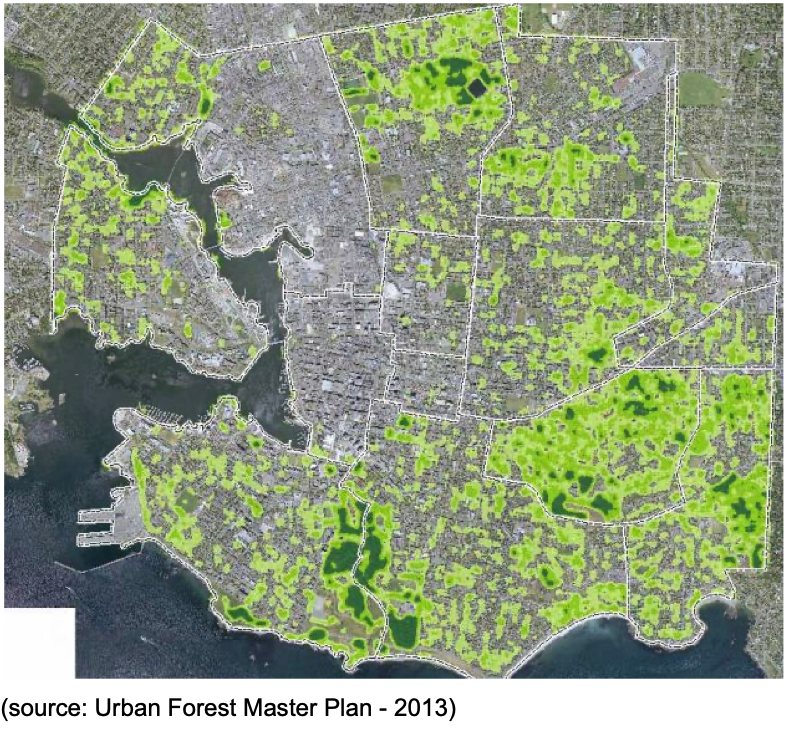
The Gonzales neighbourhood contains the second highest remaining forest cover in
Victoria (after Rockland).
Gonzales also contains intact understory and sensitive ecosystems to support a
range of birds and wildlife associated with this tree cover. This is unique to Victoria
as virtually the rest of the city has been altered or paved over.
It is possible that one or more of a variety of threatened and endangered species,
known from nearby locations, may be found in these intact ecosystems ; some of
them federally listed as endangered species:
Syntrichia laevipila – twisted oak moss
Sericococarpus rigidus – white-top aster
Coast Microseris – Microseris bigelovii
Purple Sanicle – Sanicula bipinnatifida
Victoria’s Owl-clover – Castilleja victoriae
Golden Paintbrush – Castilleja levisecta
Coastal Scouler’s Catchfly – Silene scouleri ssp. grandis
Seaside Bird’s-foot Lotus – Hosackia gracilis
Bear’s-foot Sanicle – Sanicula arctopoides
June 4, 2019″Bearded Owl-clover”
– Triphysaria versicolor (except current taxonomic studies suggest it is an
undescribed species related to T. versicolor)
Rosy Owl-Clover – Orthocarpus bracteosus
California Buttercup – Ranunculus californicus
Macoun’s Meadowfoam – Limnanthes macounii
Dense-flowered Lupine – Lupinus densiflorus
Foothill Sedge – Carex tumulicola
Water-plantain Buttercup – Ranunculus alismifolius
Dense Spike-primrose – Epilobium densiflorum
Island Common Ringlet – Coenonympha tullia ssp. insulanis
Taylor’s Checkerspot – Euphydryas editha ssp. taylori
Island Marble (believed extinct but recently rediscovered on San Juan Islands) – Euchloe ausonides
insulana
Kincaid’s Lupine (extirpated from Canada) – Lupinus oreganus ssp. kincaidii
Deltoid Balsamroot – Balsamorhiza deltoidea
The City of Victoria therefore has the legal imperative to consider these species in
future development.
The concentration of these trees and understory are primarily found in two areas:
Queen Anne Heights and Gonzales Hill. There is a natural progression from these
two areas through to Rockland. This entire area could be considered a natural bird
and animal corridor linking the two communities.
Maintaining trees and understory should be a priority in this area. This is not to say
there are not important pockets of intact ecosystems in other parts of Gonzales; only
that this corridor offers an opportunity to create a larger intact ecosystem. In
conservation biology it is better to protect large, contiguous areas for wildlife as they
stand a better chance of surviving than small isolated pockets. Nevertheless every
natural area with intact understory should be considered for protection.
What does this mean to those properties that contain intact sensitive ecosystems?
We propose that those landowners who are willing to protect sensitive ecosystems
on their land receive compensation for doing so as this is providing a public good.
We suggest that the city consider providing a reduction in yearly taxes
commensurate with the value of this ecosystem.
Determining what and where sensitive ecosystems are located would require the city
do some mapping and consulting with Biologists. In this instance this would not
require much time and money as there is little remaining habitat to evaluate.
Direction on how to proceed could be given by the municipality of Saanich as they
have already gone through a similar process.